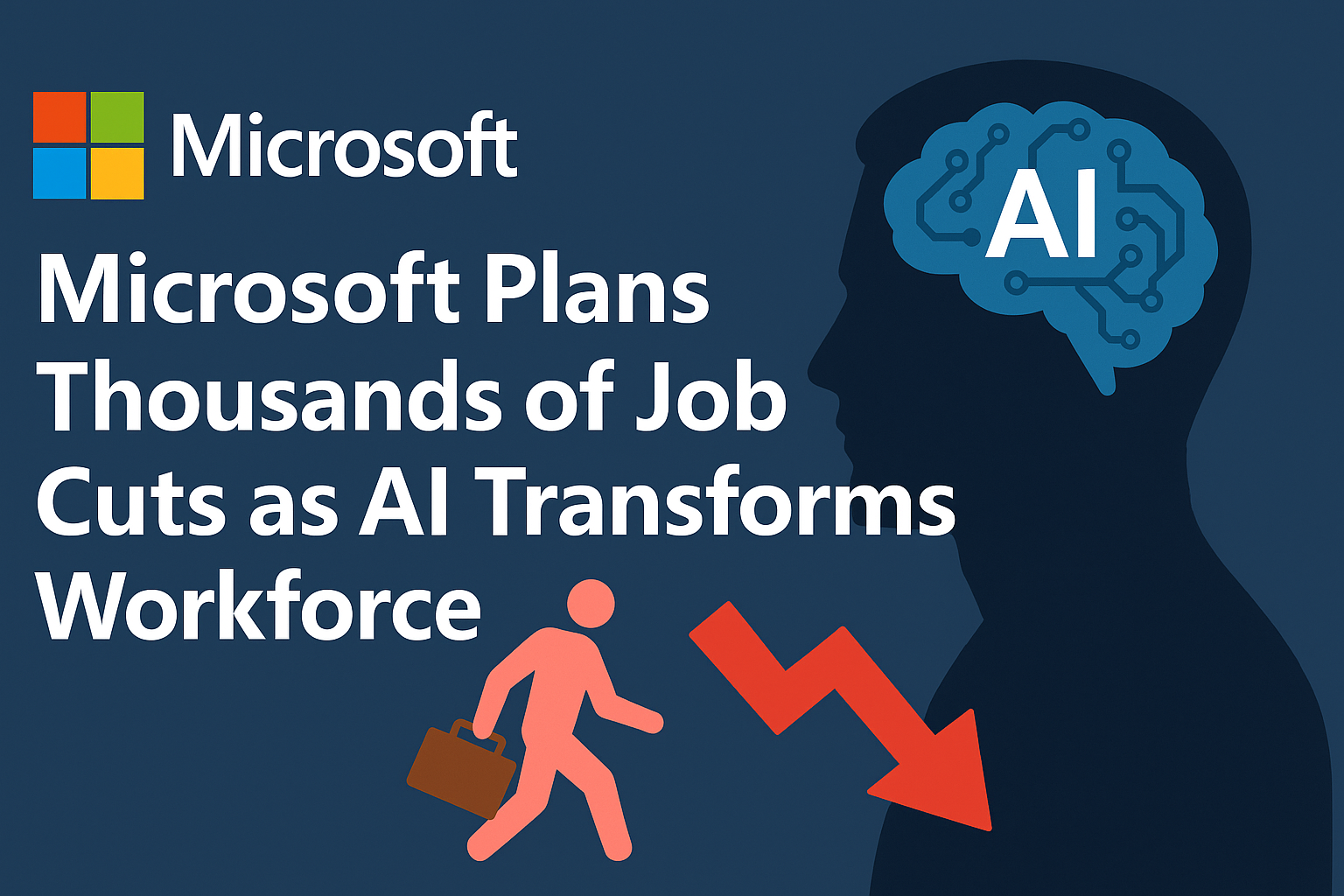
Microsoft will eliminate thousands of jobs beginning July 2025, primarily targeting non-AI roles, as it reallocates resources toward AI innovation. The move is part of a broader trend across the tech industry where automation and AI adoption are reshaping traditional job functions.
Microsoft Plans Major Job Cuts as AI Boom Reshapes Its Workforce
Microsoft is making waves again—but not for a shiny new product or blockbuster feature. This time, the tech giant is in the spotlight for a bold restructuring plan that will impact thousands of employees, signaling a major shift in how the company envisions its future in a world increasingly dominated by artificial intelligence.
💡 A Strategic Shift Fueled by AI
The layoffs, set to begin in early July 2025, are part of Microsoft’s larger plan to reallocate resources toward AI and cloud infrastructure. With a jaw-dropping $80 billion investment lined up for AI-focused data centers this fiscal year, the company is clearly betting big on smart technology.
But that aggressive move comes at a cost.
Teams in sales, customer support, and other traditional roles are being scaled back to make room for more automation, more efficiency, and more AI-powered systems. These aren’t just minor tweaks—the company is fundamentally reengineering its workforce around its long-term AI vision.
📉 Why Sales Is on the Chopping Block
Microsoft’s sales teams have traditionally relied on personal relationships, outreach, and negotiation. But now, AI tools are doing much of that heavy lifting—from lead generation to follow-up, customer tracking, and even quote management. With automation and outsourcing taking center stage, many internal roles are being eliminated, especially those connected to small and mid-sized business accounts.
The move reflects a wider trend in the tech industry: smart systems are replacing manual work. And in Microsoft’s case, this means significantly trimming down internal teams to drive leaner, AI-assisted operations.
📈 A Soaring Stock Price, But at What Cost?
While job cuts dominate the internal conversation, Wall Street is celebrating. Microsoft’s stock recently hit an all-time high, trading above $480, driven by optimism around AI investments and infrastructure expansion. Investors are clearly thrilled.
But that soaring stock comes with an emotional toll. Thousands of loyal, long-serving employees—many of whom helped build Microsoft into what it is today—are being shown the door. The contrast between rising profits and job losses highlights the complex nature of this corporate transformation.
🤖 AI Is Reshaping the Entire Industry
Microsoft isn’t alone. Across the tech sector, giants like Amazon, Google, Meta, and Salesforce are downsizing roles in areas where AI tools are becoming more reliable and more cost-effective than human labor. Code generation, customer service, project management—many functions are getting streamlined, sometimes eliminating the need for whole departments.
This is not about poor performance. It’s about new priorities.
During an internal company call earlier this year, Microsoft CEO Satya Nadella stressed that the layoffs weren’t a reflection of failure, but a necessary step in shifting the company toward a more AI-centric operating model.
💔 Real People, Real Impact
Behind the numbers are real stories. The previous round of layoffs in May saw more than 6,000 employees lose their jobs. Many were shocked, including those in high-performing teams and even those working on AI projects themselves.
One former executive described the day as “a day with a lot of tears.” Others posted heartfelt messages on internal forums and social media, expressing gratitude, confusion, and concern about what comes next. It’s clear this transition, however strategic, is not painless.
🧭 What Happens Next?
Microsoft’s fiscal year ends on June 30, and the new layoffs are expected to be announced shortly after. While most of the affected roles this round are in sales, there’s concern that customer service, partner support, and other areas could also be impacted.
For Microsoft, this is about preparing for the future. The company is pushing deeper into AI cloud services, expanding its Copilot integrations, and refining its developer tools with built-in intelligence. The workforce needs to evolve with that vision.
For employees, however, this marks a turning point. Those staying will likely face new expectations, tighter structures, and increasing pressure to embrace AI tools. Those leaving may need to retrain, pivot industries, or enter a job market flooded with fellow experienced professionals.
✍️ Final Thoughts for Your Readers
Microsoft’s massive restructuring is more than just a corporate shake-up—it’s a reflection of where the future of work is heading. AI isn’t just a buzzword; it’s a business strategy. And while it may create new opportunities, it will also leave many behind.
This story isn’t over. In fact, it’s just beginning.
If you're in tech, sales, or support roles—now is the time to upskill, specialize, and adapt. The age of AI is here, and the workforce is being rewritten in real time.














Comments 0