
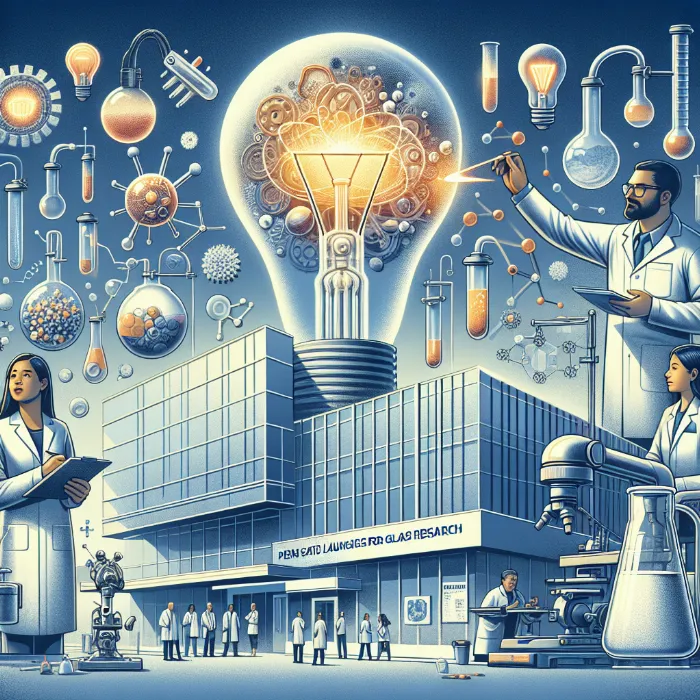
Penn State has announced the launch of a Center for Glass Research aimed at advancing glass science, accelerating industrial partnerships and addressing sustainability and energy challenges in glass manufacturing.
Penn State has announced the launch of a Center for Glass Research aimed at advancing glass science, accelerating industrial partnerships and addressing sustainability and energy challenges in glass manufacturing.
Pennsylvania State University announced the creation of a new Center for Glass Research this week, positioning the university to play a central role in rejuvenating academic and industrial interest in glass science. The interdisciplinary center, which brings together materials scientists, chemists, engineers and industry partners, aims to tackle technical challenges in glass materials, develop sustainable manufacturing pathways and foster workforce development for an industry that remains both technologically vital and energy-intensive.
The new center is intended to serve as a hub for fundamental and applied research in glass systems, from traditional silicate glasses used in architecture and containers to specialty glasses for optics, displays, batteries and photonics. According to the university announcement, research themes will include:
In a broad sense, the center aims to link fundamental materials science with engineering scale-up and commercialization pathways, reflecting longstanding calls in the academic and industrial communities for closer ties between research institutions and manufacturers.
Glass is ubiquitous in modern life — from container glass and architectural glazing to high-specification glasses used in optical systems, fiber optics and advanced displays. Despite its prevalence, research in glass science has often lagged behind other materials fields such as semiconductors, polymers and metals. Observers say this is due in part to the perceived maturity of many glass applications, the complex non-crystalline structure of glass that complicates predictive modeling, and historically lower levels of targeted public and private investment relative to other materials.
At the same time, new technological demands are driving renewed interest. The move toward lightweight, energy-efficient buildings raises demand for advanced glazing. The expansion of consumer electronics, electric vehicles and renewable energy systems relies on specialty glasses with tailored optical, mechanical and thermal properties. And as industry and governments pursue decarbonization, reducing the energy intensity of glass production and increasing recycling rates have become priorities.
According to market research estimates, the global glass market is valued in the tens of billions of dollars and is expected to grow in the coming decade as construction, automotive and electronics markets expand. A 2023 industry analysis described steady demand for architectural and container glass alongside faster growth in specialty glass sectors, although exact market figures vary by source and methodology (Grand View Research — Glass Market).
Glass manufacture is an energy-intensive process. Melting raw materials at high temperatures consumes significant amounts of fuel and electricity, contributing to greenhouse gas emissions. Industry groups and policy experts have highlighted several avenues to reduce the sector’s environmental footprint, including:
Industry associations and international analysts have called for more research to make these strategies cost-effective at scale. The launch of Penn State’s Center for Glass Research coincides with growing policy emphasis on industrial decarbonization and circular material flows in the United States and Europe (International Energy Agency).
The center is structured to support both core university research and collaborations with industry partners. It will coordinate laboratory facilities, seed funding for early-stage projects and workforce-training opportunities, including internships and short courses for industry personnel. The announcement highlighted plans to connect with regional manufacturers and national industry groups to accelerate technology transfer.
Industry-university collaboration has been a recurring theme in successful technology translation. Centers that combine computational materials science, experimental validation and manufacturing know-how tend to have higher rates of commercialization. Penn State’s center is positioned to draw on the university’s existing materials science programs and its engineering and polymer science expertise.
The establishment of the center was welcomed by academic and industry observers who emphasized both the scientific and economic potential of renewed investment in glass research.
'The launch of this center is an important step toward rebuilding a pipeline of glass innovation that connects fundamental science to manufacturing,' said a materials science researcher familiar with industrial partnerships. 'Glass is deceptively complex; small changes in composition or processing can produce large changes in performance, so coordinated programs that link theory, experiment and scale-up are essential.' (See the university announcement for the center’s objectives: Penn State News.)
An industry representative highlighted operational and environmental drivers: 'Meeting the demand for higher-performance and lower-carbon glass will require new chemistries and process technologies that are practical for mills and furnaces. Academic centers that work directly with manufacturers can help reduce the time between discovery and deployment,' the representative said in a statement to industry media (Glass Industry Association).
The center signals several specific research directions likely to attract attention from both academics and industry stakeholders:
These topics address both near-term commercial opportunities and longer-term scientific challenges. For example, smart windows and advanced glazing have immediate market relevance in construction and automotive applications, while predictive models of glass behavior remain a deeper scientific challenge because glass lacks long-range crystalline order.
Details on the center’s funding structure were not fully disclosed in the initial announcement, but university-led centers typically combine internal university support, external grants from federal agencies and contributions from industry partners. Potential federal funding sources for glass and materials research include the National Science Foundation (NSF), the Department of Energy (DOE), and targeted programs focused on advanced manufacturing and clean energy technologies.
Historically, investments in applied materials centers have had measurable economic impacts through new product development, startup creation and workforce training. A 2019 analysis of university-industry research partnerships found that centers focused on applied materials often produce licensing opportunities, cooperative research agreements and joint ventures that contribute to regional economic growth (National Science Foundation).
Regional economic development leaders often point to such centers as anchors that draw manufacturing investment and skilled talent. Pennsylvania’s manufacturing base and supply-chain ecosystem for materials could benefit from a local center focused on glass, particularly if collaborations reduce barriers to adopting newer, lower-emission manufacturing technologies.
A central objective of the new center is workforce development. The glass industry has faced workforce challenges including an aging labor force, a skills gap for advanced manufacturing, and limited visibility among students compared to higher-profile fields like software engineering. The center plans to offer:
Training engineers and technicians to operate and maintain advanced glass-making equipment, to implement energy-efficiency measures and to design for recyclability will be essential if new technologies developed by the center are to be deployed at scale.
While the center’s ambitions are wide-ranging, several challenges could constrain impact:
Addressing these challenges will require sustained funding, close industry collaboration, and mechanisms to test prototypes under real-world manufacturing conditions. Centers that have succeeded in similar areas often emphasize early engagement with manufacturers, shared testbeds and flexible funding mechanisms that bridge risk between universities and companies.
The new center reflects broader shifts in materials research priorities. In recent years, governments and research funders have emphasized materials that enable energy transitions, sustainable manufacturing and resilient supply chains. Similar centers have been established for battery materials, polymer recycling, and semiconductor manufacturing; each demonstrates that concentrated, cross-disciplinary efforts can accelerate problem-solving and technology transfer.
Glass research intersects with many of these priorities: energy efficiency in buildings, lightweight materials for transport, durable and recyclable packaging, and substrates for renewable energy devices. By aligning research with these national and commercial priorities, the center seeks to attract partnerships and to demonstrate concrete environmental and economic benefits.
The launch of Penn State’s Center for Glass Research represents an effort to reassert glass science as a field of strategic importance, coupling fundamental research with applied engineering and industry collaboration. By focusing on energy efficiency, recyclability and novel glass functionalities, the center aims to address longstanding technological challenges and to help industry reduce emissions and improve product performance. Success will depend on effective partnerships with manufacturers, secure and sustained funding, and the ability to scale laboratory advances into cost-effective industrial processes. If those elements come together, the center could become a model for how academic institutions catalyze innovation in mature yet critical materials sectors.
Disclaimer: This article is based on publicly available information and does not represent investment or legal advice.
Like
Dislike
Love
Angry
Sad
Funny
Wow



What a 100% Tariff on Computer Chips Would Mean for Consumers, Industry and the Global Supply Chain
October 08, 2025
Bitcoin ETFs See $501 Million Inflow 14th Day in a Row, Ethereum ETFs Gain $77.45 Million
June 28, 2025
'In business, indecision is killer' - Canadian firms seek certainty in tariff war
June 28, 2025
Affordances in the brain: The human superpower AI hasn’t mastered
June 23, 2025








Comments 0